Thursday, October 13, 2011

Now Is The Time For Running by Michael Williams

"What is worse than the sound of wood against the bones of your brother?  I cannot think of anything worse than that."
 
This book just plain broke my heart. It's a powerful, hard story out of Zimbabwe and South Africa, but for me  the location faded away after a while because the characters and events  grabbed my attention so forcefully.   This is the kind of book I think of when people talk about literature's power to make us understand "the other", because really, what could be more different from my life than the experience of a homeless teen refugee whose one link to "normalcy" is his love of  soccer?  But anyone who understands not belonging,  or the strength of the love you can feel for someone you need to protect, or the way hope and fear can heighten and fuse together for people in desperate conditions will completely get this book.

Now Is The Time For Running is the story of Deo, who must flee his native village in Zimbabwe with his older brother Innocent when soldiers come to town and slaughter everyone in the name of the President.

"I am Commander Jesus.  I am one of the president's men.  I was once a leader of the Five Brigade.  The president has sent me here because he is unhappy with how you voted in the election.  Most of you know that this country was won by the barrel of the gun.  There are some among you who fought in the war of liberation.  I see it in your eyes.  You know who you are, and you should be ashamed of your neighbors.  You know what sacrifices were made for the freedom we now enjoy.  Should we now let it go at the stroke of a pen?  Should one just write an X and let the country go just like that?  You voted wrongly at the election.  You were not thinking straight.  That is why the president sent me here."

Deo and Innocent escape the carnage with their lives, and are the only ones in their village to do so.  But the soldiers may return, and they must not be found.  Where to go?  Their mother had a friend in the police force of  a nearby city, but even he cannot help them--when they flee to Captain Washington's home, the soldiers are there too.  Captain Washington tells them that they must escape to South Africa.  Maybe they will be able to find their father there.  The journey is insanely dangerous, and when they finally arrive,  they find that the safe haven they have been running to is less welcoming than they could ever have imagined.

Sometimes I think it's harder to read certain types of stories as an adult than as a child, for all that children are supposed to be more sensitive.  Children are also more comforted by the happy ending.  But as an adult, I know how the numbers break down--the number of children in the world who are refugees or survivors of political violence  (lots) versus the numbers of teen refugees who are plucked off the streets and chosen to participate in the Street Soccer World Cup (precious few).  I'm not saying the ending felt fake, exactly.  It just felt a little desperate, like it was worked in because nothing that might more realistically happen is going to repair the damage that has been done to lives we have come to care about.   The three young men who provided Williams with background interviews for this book are still homeless and are currently living "on the streets of Cape Town, under highways, and wherever they can find shelter.".  Their lives are the reality behind the fiction.

I haven't even mentioned the crux of the story, that Innocent is intellectually challenged and subject to seizures and obsessive-compulsive behavior.  He's a prime target for bullying at the best of times, and not exactly easy to smuggle around.

"I once had a brother.  His name was Innocent.  He was a very special person and he was my best friend."

This is a great book.  Read it when you're feeling strong.

Saturday, October 1, 2011

God as a Teenage Boy: There Is No Dog by Meg Rosoff

"The truth of this could not be denied.  Bob had created the world and then simply lost interest.  Since his second week of employment, he'd passed the time sleeping and playing with his wangle, while managing to ignore the existence of his creations entirely.


And was this an excuse for him to be rained with curses and loathing from all mankind?  Oh no.  Because here was the clever bit:  Bob had designed the entire race of murderers, martyrs and thugs with a built-in propensity to worship him.  You had to admire the kid.  Thick as two lemons, but with flashes of brilliance so intense a person could go blind looking at him."


Anthony McGowan's Guardian review of Rosoff's latest novel suggests that "there isn't another young adult novel like There Is No Dog", and goes on to compare Rosoff's writing with Evelyn Waugh, Muriel Spark and Kurt Vonnegut (for "intellectual playfulness").  What There Is No Dog reminded me of was the Hitchhiker's Guide to the Galaxy series;    There Is No Dog is more grounded (it takes place mostly on earth, not on alien spacecraft) and more emotionally nuanced (the Hitchhiker's Guide, as I recall, is pretty much a straight-up parody).  But the books share the same kind of goofy absurdist take on a some of mankind's most vexed questions (Hitchhiker contemplates the meaning of life, while Dog takes a good hard look at the world and extrapolates the nature of God).

So, God.  He's a teenage boy, name of Bob.  He got the job of Creator of Earth because his wacko mother won it for him in a poker game. ("Bob's credentials (non-existent) did not impress.  But the general sense of exhaustion and indifference was such that no one could really be bothered to argue.")  He's sloppy, lazy, immature, whiny, lacking in compassion or responsibility.  He's lustier than the Rolling Stones in heat and prone to falling in and out of love dramatically and dangerously.

'Mr B remembered another girl, another time, with the face of an angel and the sweetest manners, a child's soft mouth and an expression open and trusting as a lamb.  She had seen Bob for what he was, and loved him anyway.  Mr B removed his spectacles, hoping to erase the vision in his head.  That romance had ended with floods, tornadoes, plague, earthquakes and the girl's execution for heresy, a few weeks before her fourteenth birthday.  By special order of Pope Urban II.  


And, just our luck, this loser has gone and created man in his own image, "which anyone could see was one big fat recipe for disaster."  


Earth's only saving grace is that Mr. B, God's  administrative assistant, does care about earth and its creatures and tries his damndest to straighten out Bob's messes.  (Right now he's dealing with the biblically-proportioned floods caused by Bob's trying to seduce a young girl named Lucy.)  But Mr. B is nearing the end of his rope and has applied for a transfer.  Who will look after creation now?

Although There Is No Dog sounds like it could be desperately cynical, in the end it isn't.  Despite God's blunderings, miracles unexpectedly occur and death is cheated, at least for the moment.  People have hope, and it doesn't feel empty. And it may turn out that our slacker of a God can be overthrown....

Nothing is finally resolved in this book, but then again, that's life, isn't it?

Monday, September 26, 2011

The Sky Over the Louvre by Jean-Claude Carrier and Bernar Yslaire

I reviewed this gorgeous graphic book over on my work blog.  If you're into art or history,  go give it a read!


Monday, September 19, 2011

Level Up by Gene Luen Yang, Illustrated by Thien Pham

"To provide that boy with the life he has, I've had to eat much bitterness.  He must learn to do the same.  How will a video game teach him to eat bitterness?" 

Hmmm.  Gene Luen Yang.  He's one of those writers that for me can go either way.  He made his reputation with American Born Chinese, the first and (so far) only graphic novel to win the Michael L. Printz award for excellence in young adult fiction. It was fresh and ingenious, and I liked it a lot.  He followed up with The Eternal Smile, which got great reviews but left me cold, and Prime Baby , which I thought was clever and funny but less complex than his first book.  In Level Up I think we're seeing him return to his strengths.  Level Up is relevant, surprising, engaging, imaginative.  Writing about the pressures of parental expectations on young people who live in our pleasure-centric culture, Yang invites readers to think about whether it is our destiny to fulfill our family's hopes and dreams, particularly if they have sacrificed their own for us. 

Level Up follows the life of Dennis Ouyang, a high-schooler back in the early days of pac-man. Dennis is enthralled by this new game, and eagerly asks his father for a Nintendo Entertainment System for Christmas (he does this by taping pictures of it to his father's mirror, his newspaper, the fridge, etc.--he and his dad aren't really big on talking together).  His parents, to his crushing disappointment,  get him a chemistry set instead and his dad leaves notes around the house entitled "How to get into college", "The job market", and "The virtue of work".  There, in a nutshell, is the heart of the story.

Dennis works hard and does well in high school to please his parents, but when his father dies just before high school graduation, Dennis immediately goes to an electronics store and gets a game system.  On his way home from the funeral.  Literally.  He becomes a hard-core gamer, flunking out of his $10,000.00-a-year college because he is too distracted to study or attend classes.  And then--a miracle!

Angels enter Dennis's life.  Four adorable little floating angels who tell him that his destiny is in gastroenterology ("Great shall you be in your profession!", they earnestly proclaim).  Four very bossy angels who seem to have come from his father, who bully the dean into re-admitting him to college, who get him to give away all his games and gaming systems, and who move in with him to keep him on the straight and narrow.  But the road to  gastroenterology is long, hard, and smelly.  Does Dennis have what it takes to endure?  And even if he can, should he? 

What I like about Level Up  (apart from the imaginative twists and turns of the story) is the multi-faceted  point of view from which Yang explores this dilemna.  Many books, movies, and tv shows for teens are all about living your dreams, letting your passions direct your life, and not letting anything get in your way.  Yang shows both sides of the equation:  how hard it is to work towards something that doesn't inspire you, but also, how practical goals can keep us from frittering away our lives. 

Here's a link to an interesting interview with both Yang and illustrator Pham, and here's a link to Yang's website.   And finally, here's a video of Yang and Pham talking up their book at San Diego Comic Con, and a link to a comic Yang made explaining the "secret origins" of Level Up


And just in case you're unfamiliar with it,  here's a trailer for  American Born Chinese.  It's worth a read too.


Wednesday, September 14, 2011

Happyface by Stephen Emond

"Today is the day the world changed, and that is all I will say because I don't ever want to think of it again."    
   
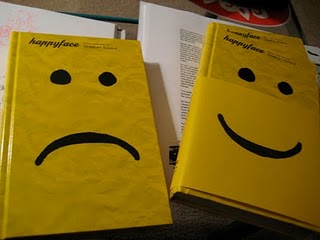
Happyface reminds me a lot of one of my all-time favourite picture books, Michael Rosen's Sad Book.  Like the Sad BookHappyface deals with grief that morphs (as it so easily does) into long-term depression. It also reminds me of Sherman Alexie's The Absolutely True Diary of a Part-Time Indian in that it is heavily illustrated with the narrator's sketches,  and the illustrations do a great deal to enhance the mood of the story. There's a lot going on here visually--starting with the cover. With the book jacket on, we see a happy face, but if we look underneath, the face is sad. (Just like Quentin Blake's brilliant first-page illustration for the Sad Book).


Happyface is about an artistic guy whose family falls apart in a horrible way (how horrible it is, we don't learn until about halfway through the book because Happyface can't talk about it) which leaves him feeling deeply betrayed as well as permanently grief-ridden.  Happyface and his mother move to a small apartment in a new neighbourhood where his mother drinks too much and rides a private and painful emotional roller coaster, and he goes to a new school where no one knows him.  Happyface decides to reinvent himself, and at first he's pretty successful.  He "slaps on a grin", gets his nickname, makes friends with the cool crowd, and starts chasing a girl who's beautiful, reads Allen Ginsberg and seems to like him back.  He's fooling everyone. 


Of course, eventually everything crumbles around him, because a) people start digging for the truth, and b) he starts going just a little nuts, in the way that happens when you repress such powerful feelings.  He turns mean and desperate.  We're not even sure we like him anymore.  

Emond has chosen to give us the closure of a hopeful ending, although I really felt that this book could have gone either way.  Happyface mends some rifts, particularly with his father, and vows that "my problems and failures will not stop me, nor will they dictate who I am".   Frankly, the ending wasn't my favourite part.  What I found fascinating was how well Emond captured the complications of functioning in a depressed state, because, let's face it, Happyface is right--grief and rage are big social turn-offs for most people, particularly if they last a long time.  Sometimes the mask is what saves us. 


I also found the illustrations extraordinarily engaging.  They're plentiful, sometimes cartoony and sometimes more artistically rendered, and they add a lot of energy and vitality to what could otherwise have been a much more sober story.  Here's an interesting article written by Connie Tsu on the Blue Rose Girls blog about the process of editing  a book as visual as Happyface.  Enjoy!

Wednesday, September 7, 2011

Mirages Don't Have Chicken Breath, Mister: The Trouble With Chickens by Doreen Cronin

"There's an easy way to do a search and a hard way.
 The easy way is early in the evening with a cool breeze and a steady partner.
The hard way is high noon with a crazy chicken clucking in your ear and two feather balls riding your tail.
 This search was gonna go the hard way."

This easy chapter book lends itself to dramatic reading.  It's a send-up of the hard-boiled detective genre;  J.J.,  a retired search-and-rescue dog, is hired by a local chicken to find two missing chicks (he won't work for chicken feed or feathers, but she promises him a cheeseburger).  There are lots of good bits to act out, like:

"I never backed down from a staring contest in my life, but her eyes were so tiny and close-set, it was making me cross-eyed."

or:

"I sucked my breath in through my nose as hard as I could.  Sugar was dragged right between the two bars and stuck to my nose like a stray sock on a freshly dried towel."

(Sugar is one of the missing chicks. Just picture it. )

Jokes abound, and they're really funny.  One of them involves a ransom note which contains the words "behoove", "rendezvous", and "twilight".  Our sardonic narrator J.J. observes:

"I've been lowered from a helicopter, strapped to a snowmobile, and flown first-class to France to find a backcountry skier lost in the Alps.  
Not once did anyone find it necessary to use the word behoove."

If I want to get a laugh out of my son now, all I have to do is tell him that it behooves him to rendezvous with me at the dinner table. 

Like many of the best books for this reading level, lots of illustrations add interest to the text.  Here's J.J. enjoying retirement, and J.J. in a peck (bad pun) of trouble.


Just can't trust those chickens. 


Tuesday, September 6, 2011

Appetite for Detention by Sloane Tanen

It's back-to-school time.  Since my daughter's going into grade eight, I thought the time for reading her picture books was long over, but that was before I stumbled upon  Appetite for Detention.  Yes, she was skeptical when I offered to read her a bedtime story for old times sake, but the first ridiculous page won her over.  It's the contrast between the cute little toy chicks and the angsty-ironic teen dialogue that makes the book such a laugh.   Sloane Tanen has made a niche for herself creating these kinds of images with attitude, so if you like the book, check out her website.

Here are a few sample pages:


If I were in high school now, I'd tape these to my locker.