Showing posts with label children's books. Show all posts

Saturday, December 22, 2012

The Adventures of Sir Gawain the True by Gerald Morris

Of all the Arthurian tales, the story of Sir Gawain and the Green Knight is one of my favourites.  I read the original in high school, and I found it so dramatic and vigorous and full of personality.   (Mind you, I also read and loved Mark Twain's A Connecticut Yankee in King Arthur's Court. That's full of personality in a different way.) Since then I've read a few different adaptations of Gawain's adventures,  including a Tolkien edition which I read not too long afterwards, and a children's version by Selina Hastings (she also wrote a great version of Sir Gawain and the Loathly Lady, another fine tale).  Now Gerald Morris has come out with a chapter book version of the Green Knight Incident aimed at younger children (grades 2-4 is probably the target audience) as part of his Knights' Tales series.  These books bring a very fresh feeling to Arthurian stories for kids.   Morris's tone is a little like a Boy's Own Adventure story, but more literate.  It's respectful of its source material, down to earth, and full of cheerful humour.  It's also very clear and readable,  just right for emergent readers.  

"But what many do not realize is that, at least in King Arthur's court, knights were also expected to be very courteous and respectful.  The king was very clear about this:  He wanted no bullies at his Round Table.  In fact, he said that courtesy was even more important than wearing metal suits and bashing people from horses.  Not surprisingly, this notion took a while to sink in.  Knights who had spent their whole lives learning swordsmanship and pointy-stick-bashing did not always see how something else could be more important.  Indeed, King Arthur had reigned for several years before he felt that his knights were starting to get the idea."

Morris's story follows the trajectory of the original:  the Green Knight's challenge at King Arthur's Christmas Feast, Gawain's commitment to the Knight's beheading game, his year of wandering, his stay at the Green Knight's castle and the exchange of prizes (the kissing game is toned down a lot here) and finally his visit to the Green Chapel, where he discovers that the whole thing has been an elaborate test of his (and by extension, King Arthur's) chivalry and knightly honour.

I think what Morris does best is to turn these mythic characters into concrete personalities, characters which are not necessarily so lofty but who still do King Arthur's court proud.  Kids are going to root for these knights, and the books will lay a great foundation for appreciating more mature versions of these stories later on.  Or for appreciating Monty Python and the Holy Grail, as the case may be.

Currently, other books in the Knights' Tales series include The Adventures of Sir Lancelot the Great;  The   Adventures of Sir Givret the Short, and The Adventures of Sir Balin the Ill-Fated.  I have to mention that Aaron Renier does a great job of illustrating--don't you love that Green Knight cover?


My original Sir Gawain, read when I was about 16. 


Tolkien's translation.  I don't remember anything at all about Pearl or Sir Orfeo.   Only the Green Knight stuck with me.

Selina Hasting's children's adaptation of the Loathly Lady story, another time Gawain gets into hot water. 

Another of the Knight's Tales series. 

Friday, December 23, 2011

Beauty and the Squat Bears by Emile Bravo

"Pfft!  A prince, a prince...Now where am I supposed to find one of those?"

Ahh, that age-old question.... 

Emile Bravo is an award-winning  French comic writer and illustrator whose work for older children and adults I have been drawn to for its originality and emotional depth.  His Seven Squat Bears series (The Hunger of the Seven Squat Bears, Goldilocks and the Seven Squat Bears, Beauty and the Squat Bears) is his first foray into writing for younger children, and he handles the transition with panache.  The Squat Bears were an instant hit in France, and it's not hard to see why.  They're all clever fairy-tale mash-ups which are full of personality,  funny as heck, and just right for an elementary-school audience.   Beauty and the Squat Bears is my personal favourite, with its zany plot and derriere-kicking  fairy godmother.

So what do I like so much about these books?  First of all, I love the drawings...especially the bears.  They're the straight men in these stories and their expressions are priceless.  Especially when they're being grouchy and cynical.


Bravo's illustration style has been described as "clean, expressive and ironic."  I think his style, which is actually quite detailed although it manages to look fresh and uncluttered, is perfect for this age group.  I like the rich, saturated colours he uses.  I also like how he hasn't made the bears "cute".  They really are squat, rectangular almost, and it gives them a very business-like appearance.  Especially when they're stalking through magic forests looking for princes to solve their princess problems.  

The dialogue is snappy:

"'Ohhh!  Pleeeease, let me stay with you.  I'll do whatever you want...'
'Even chores?'
'Huh?  I don't think so!  After all, I am a princess...'
'So, what can a princess do?'
"Huh?  Well, marry a prince, duh!'"

And a little later on:

"'Alas!  A sorcerer put a curse on me that turned me into a bird for seven years...'
'Seven years!  No way!  That'll never do!  I need a prince right here, right now.  It's to get rid of a princess!'
'A PRINCESS?!  HOLD ON, WAIT!  WE CAN WORK THIS OUT!'"

I've heard that there is a fourth Squat Bear book coming out in french this year (Le Sept Ours Nains et Compagnie).  Hopefully the translation will be with us soon!

Monday, June 13, 2011

Mother Number Zero by Marjolyn Hof

"I think that from the very beginning Bing was always more curious.  A Chinese parasol hung from the ceiling in her room, and she owned a pair of Chinese pajamas.
'Why don't you get a Chinese tattoo?' I said.
She pointed at her butt.  'Here?'
'No!' said my mother.
'Yes, right there,' I said.  'Get a dragon.'
'But it has to be a  big one,' Bing said.  'A mini dragon would be useless.  You'd barely see it.'
'Big and colorful,' I said.  'So it catches your eye.  Red, green and blue.'
'And yellow.' Bing said.
My mother looked relieved.  'You're overdoing it.  I don't believe you anymore.'
'Overdoing it?' said Bing.  'It's my butt and I can do what I want with it.'
'It's also a little bit mine,' my mother said.  'I wiped it for years.'
'All mothers do that,'  Bing said.  'That doesn't mean a thing.' "

Dutch author Marjolyn Hof's Mother Number Zero is a quiet and sensitive story about adoption.  Fejzo, called Fay, is part of a Dutch family with two adopted children.  His sister An Bing Wa, or Peace-Loving Ice Baby, was adopted from China, while Fejzo's mother was originally from Bosnia.  He has a child-like understanding of his past:

"My mother number zero lived in Bosnia and I was in her belly.  Mother number zero didn't want a baby.  She couldn't take care of me and that was the reason she gave me up.  Luckily she didn't give me away to somebody in her own country, because they had a war and far too many problems.  She was smart enough to come to the Netherlands, and I traveled along in her belly."

Fay doesn't give too much thought to his adoption until he meets Maud, a newcomer who is very curious about Fay's birth mother.  Maud thinks that Fay's birth mother might be a famous artist, since Fay himself is accomplished at drawing birds.  She suggests that Fay might be able to find his mother number zero with a bit of detective work, just like on a TV show called Disappeared, where "they search for someone's father or mother and then you can see what happens."   The curiosity Maud exhibits eventually stirs something within Fay, and once he begins wondering about mother number zero, he can't seem to stop.

With his parent's assistance, Fay begins to take steps to find his birth mother.  Fay doesn't initially understand the difficult feelings this search may spark for both himself and his family, particularly his sister, who was found abandoned and therefore has no means of tracking her birth family.  In him, the search evokes many fantasies, some exciting and some frightening. 

"And mother number zero?  She had gone through a war and given her kid away....Was my mother like some people who could handle it, or like others who couldn't?  If she couldn't, then maybe she lived in a park somewhere too.  Maybe she drank beer all day long and had a knife to kill ducks.  Maybe that was the answer to the question of why she had given me away.  She had gone through so much that she had turned into a bum.  Maybe she was crazy.  Or wounded or crippled.  Maybe she didn't have a nose or only one leg or no arms."

Hof, an adoptee herself,  enters Fay's inner world with tremendous empathy and understanding.  As Fay's thoughts and feelings veer off in so many different directions, we feel safe knowing that he is blessed with parents who are kind and warm, and deeply connected with him.  Their support and guidance on his quest helps him prepare for whatever answer will come.

The ending felt right to me, and I found it very honestly and gently handled.  This is a story that is simple but never stark.  Reading it feels like taking a small pilgrimage and then coming safely back home. 


Monday, May 2, 2011

Scumble by Ingrid Law

"We had to wait until my birthday came and went.  We had to see if anything exploded, caught fire, or flooded before committing to a long-haul trip across four states in the minivan.  In my family, thirteenth birthdays were like time bombs, with no burning fuse or beeping countdown to tell you when to plug your ears, duck, brace yourself, or turn tail and get the hay bales out of Dodge." 

Scumble is a companion to the immensely popular Newbery Honor book Savvy, about a special family whose members all develop a magical talent on their 13th birthdays.   These talents, or savvys, as the families call them, are kept dead secret from the outside world and range precariously from the sublime to the ridiculous.

"My mom's side of the family had always been more than a little different.  I doubted there were many people with a time-hopping great-aunt, a grandpa who shaped mountains and valleys out of land pancake-flat, and a mix of cousins who ranged from electric to mind-reading to done-gone vanished--poof! I'd even had a great-uncle who could spit hailstones like watermelon seeds, or gargle water into vapor and blow it out his ears.  When Great-uncle Ferris turned thirteen, his savvy had stunned him with a sudden, sunny-colored snowstorm inside the family outhouse, toppling the small shack like an overburdened ice chest that rolled down the hill with him still inside it."  


13-year-old Ledger's brand-new savvy seems more like a curse than a talent.  Instead of the phenomenal running speed he had hoped for, suddenly machinery falls apart whenever he's around.  His frazzled parents leave him for the summer at his Uncle Autry's ranch, where they hope he will learn to scumble, or control his savvy.  ("Scumble" is a term from the visual arts, meaning to blend colours together or mute bright colours with a thin overlay of semi-opaque pigment).  Ledger's summer is certainly eventful--for one thing, he catches the prying eye of thirteen-year old Sarah Jane Cabot, ace reporter for the Sundance Scuttlebut, who immediately senses a mystery surrounding Ledger and his family.   And for another, his uncle may be about to lose the ranch.   But most importantly, he discovers something unexpected about himself--he is, in fact, an artist. 

There are some pretty good reasons that Savvy and Scumble have been so popular, I think.  Law is so inventive, and the savvy families she writes about are a lively and intriguing bunch.   Her writing style is rooted in the American tall-tale tradition and she really makes it work.  Scumble reminds me of those great Grandma Dowdel stories by Richard Peck.  Everything that happens is a little unexpected, a little unbelievable, but in the end, happily, it all fits together.    

Sunday, May 1, 2011

No Such Thing As Dragons by Philip Reeve

A growl bubbled softly, deep in the sound box of the creature's chest.  The eye it aimed at him was sulfur yellow.  It opened its mouth, and its teeth were icicle white and sharp as nails and its tongue was a pink spike.  As it launched itself off the crag toward him, Ansel saw the long tail lash out behind it, striped like a serpent and frilled with feathers. 

Philip Reeve's new fantasy story, No Such Thing As Dragons, really reminds me of many of the classic British children's books I read in my youth, authored by writers  like E. Nesbit or Frances Hodgson Burnett or Andrew Lang, writers who stretched my vocabulary not just because they wrote in a particular dialect but also because they were so highly literate themselves.  You can tell by reading any of Reeve's books that his magnificent sense of imagination is firmly buttressed by an accomplished command of the language of story.    He is a vigorous and skilled writer, and has given us here an adventure that would read aloud wonderfully well.

It took several hours for them to make their way around the lake to the crags on the far side.  There they picked up the path that Else's father had told her of.  Faint and faded, it dropped giddily down slopes of scree and shale into a steep-sided valley.  Spikey crags crowned with starved-looking clumps of pine thrust out into the valley, and at their feet lay the glacier.  Ansel had not quite believed it when Else and Brock talked about it--a river of ice, creeping forever down the mountain.  Yet there it was, vast and cold, hatched all over with crevices and chasms, and though he could not see it moving he could hear it:  the faint grinding and grumbling as it dragged its way over the rocks, and sometimes a crisp icy crack from the fractured surface.  

The plot is classic and straightforward.  Ansel is a 10-year-old peasant boy in a large family, who stopped being able to speak at age 7,  when his mother died.  His mercenary father sells him to a passing dragon-killer in need of a servant who isn't a blabbermouth.   The dragon-killer is in fact a fake--he carries a crocodile skull around with him to persuade frightened villagers that he has freed them from dangerous fire-breathing wyrms. But he confides early on to a frightened Ansel, "There's really no such thing as dragons".   To him, it's all a big, profitable show.  Ansel's master Brock is headed for a remote village where the villagers are convinced that the dragon who lives in the nearby mountain has awakened.  So great is their fear that they have dragged a village girl up the mountain and left her tied up in the frigid cold as a sacrifice to the great beast.  When Ansel, Brock and a wandering priest make their way up the mountain, they discover that dragons may not be so imaginary after all. 


This is the kind of fantasy that grounds itself in a sense of reality.  I like the way the dragon is conceived as a natural creature, with natural behaviors related to other animals, rather than a mythological beast.  Ansel is convincing as a quiet, sensitive boy in a rough world, gradually coming into is own.  This is a fine addition to the canon of British fantasy adventure for young readers.

Wednesday, May 12, 2010

Out of My Mind by Sharon Draper

"Words have always swirled around me like snowflakes--each one delicate and different, each one melting untouched in my hands.
Deep within me, words pile up in huge drifts. Mountains of phrases and sentences and connected ideas.  Clever expressions.  Jokes.  Love songs.
From the time I was really little...words were like sweet, liquid gifts, and I drank them like lemonade.  I could almost taste them.  They made my jumbled thoughts and feelings have substance...
Every word my parents spoke to me or about me I absorbed and kept and remembered. All of them....
I have never spoken one single word.  I am almost eleven years old.


Out of My Mind did a terrific job of taking me inside the mind of a bright young girl with cerebral palsy and very limited means of communication.  Melody cannot speak or control her most of her movements.  To converse, she needs to point at letters on her communication board with her thumbs, one slow letter at a time.  She cannot eat or drink by herself or use a toilet or bathtub independently. In school she is placed in a special needs class, where for years teachers treat her as though she were intellectually disabled.

While doing some research on Stephen Hawking,  Melody discovers the Medi-talker, a computer/communication device which could give her a voice.  The Medi-talker lets Melody demonstrate what her parents and caregivers had long suspected, that she is easily one of the brightest children in her school.  However, Melody's dream is to actually make friends with the other students and be part of the group of "normal" kids, and her new-found communication skills don't alleviate the other student's discomfort with her physical differences.  To most of her peers, Melody still seems downright strange and sometimes even repulsive. Being seen with her in public embarrasses them.  When Melody competes to be on her school's Whiz Kids team, the other kids are shocked when she gets in.   Being on a school team doesn't lead to the social acceptance that Melody had hoped for, and in a moment of crisis, Melody comes to understand that some people just aren't worth the struggle.

"I'm not trying to be mean--honest--but it just never occurred to me that Melody had thoughts in her head."

Draper is a talented writer and Melody's voice is very believable.  Although I'm not really fond of books that set out to "teach" kids about life, I do like books that can help them empathize with difference.  I think Draper has nailed that here.  Because the truth is, kids like Melody aren't that weird or scary once you get to know them--it's the initial step that's hard.  Draper lets us get to know Melody from a position of relative safety, but I'm betting that once readers get to know her, they won't forget.  And we'll be one step closer to having that inclusive world that  kids all deserve.   

Friday, July 18, 2008

Lenny's Space by Kate Banks


"All of my friends, all one of them, died."

This is a book I ended up liking quite a bit. Lenny is a boy with mild autistic-like behaviors (he is never named or diagnosed with a condition in this book) who is super-smart and incredibly socially awkward. He's interesting though. The book is told from his point of view in short chapters that sometimes seem abrupt, mirroring Lenny's attention span. You really get inside his head, and see the logic in what to others seems like bizarre, spastic behavior.

Although Lenny can't really relate to the other kids in his class, he makes a friend in the playground. Van is another mechanically inclined kid who, we discover, has leukemia. Through his friendship with Van and his weekly visits to the school counsellor, Lenny comes closer to being able to express himself in ways others can understand. I found Lenny's journey convincing and memorable.

Monday, June 16, 2008

What Ewan's Loving: Johnny Boo and company


My son Ewan, who just turned five, really loves comics. Unfortunately many of them are just a bit too dense for him still, so he tends to get bored with non-action sections and skip a lot of the story. But I've been dropping into a really cool comic store recently, and have found some reading material that is absolutely just right for him. We've been reading Johnny Boo, the Best Little Ghost in the World by James Kochalka again and again. It's apparently the first book of a new series, and we're looking forward to future titles.

Johnny Boo is a little kid ghost who reminds me a bit of Casper, very friendly and affectionate, who gets into some dramatic and exciting situations. In this story Johnny Boo and his pet ghost Squiggle meet up with an ice cream monster, and when they offer him some of their secret ice cream he gulps it down so fast he accidentally eats Squiggle too. Fortunately the ice cream monster isn't the sharpest knife in the drawer, and when Squiggle uses his Sqiggle Power, wiggling around in the monster's tummy, the monster burps him back up and all is well. The book is really visually appealing, with simple but rich blue and green landscapes and lots of dramatic body language, especially when the monster gets the burps. We love it.

Our other favourite find from this store is Geoffrey Hayes' Benny and Penny in Just Pretend. Benny is Penny's older brother, and his idea of a good time is standing in a box pretending to be a pirate on a pirate ship. Alone. Penny's idea of a good time is playing with big brother Benny. Benny's disdain is withering ("No! Pirates are brave, and you are a cry-baby.") but Penny does not give up, driving Benny to distraction until he finally bellows "Go away! You are a dumb, bad little sister!". It's so dramatic. Neither Ewan nor I can really believe he has actually said this. Penny starts to cry and Benny relents and offers to play hide-and-seek ("you hide in this box and I'll find you", he offers). Is Benny's change of heart to be trusted? Heck, no. He goes back to playing pirate and does not look for Penny. What a weasel.

Reconciliation comes when Benny realizes that he can't hear Penny. When he goes to check on her she's not in the box! He looks everywhere and when he finally finds her they end up being pirates together after all. Benny earnestly explains "Penny, before, when I called you a dumb, bad little sister...well, that was just pretend." Sheesh. I hope so.

The pictures are very sweet and lovely, with Benny and Penny portrayed as plump little mice with colourful clothes and surroundings and very expressive faces. The panels are generously sized and there is enough white space to let everything breathe. This story meets kids at exactly their level, and although I don't know a lot about these things, the quality of the book's production is obviously outstanding. A real winner.


Thursday, June 5, 2008

Hilary McKay's Casson Family

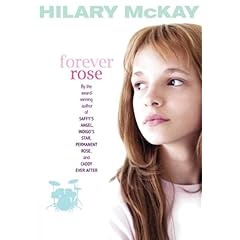
I really, really love Hilary McKay's Casson family books. When I saw the newly released Forever Rose (last of the Casson books, according to McKay, who wants to quit while she's ahead) I grabbed it and gobbled it down in two days. And then I went back and reread all the others, starting with Saffy's Angel. They were all just as good the second time around.

Truly, I can see why McKay feels that this is a good place to leave the Cassons. So much is resolved here: Caddy resurfaces after a year's absence with a mysterious bundle temporarily called Buttercup, David is thrown out of his home by his shrewish mother and takes refuge in the embrace of the Casson clan (Rose's embrace is a mite prickly, mind you--David still can't compare with Tom), and after mom Eve catches pneumonia painting in the shed, dad Bill finally decides to come home for good. It's clear that the older Casson kids are either grown up or well on their way--probably why Rose, the youngest, is the natural focal point of this last volume.

I've been thinking about some of the reasons I find reading about the Cassons so comforting. I think it is partly a fascination with the chaos that abounds in their home. The Casson house is hugely, gloriously untidy. Somehow, this mess seems connected to their creativity. No one fusses when Rose spends weeks drawing a mural of the family all over the kitchen walls; indeed, her Mom happily shoves aside furniture to make more room for it, and when Rose is done, her mother and siblings cover it with spray sealer out of respect for her endeavor. Likewise, Caddy is free to keep enormous guinea pig hutches for generations of pet guinea pigs all over the back yard. Meals may be haphazard, cakes may go up in smoke, and diamond and platinum engagement rings may get lost in the masses of stuff lying about, but guess who's home all the Casson kids' friends want to hang out in? You got it. It's kind of a kids' dream home. Unlike my house, where, inexplicably, the mess doesn't add a bit of warmth, coziness or relaxation, but only shows how chronically disorganized and pressed for time I am and makes everyone, including me, crabby.

The other quality that McKay conveys so well in these books is the particular support a loving family can give each member. The Casson home, without making a big fuss about it, is a loving, caring home. I love all the little ways the kids look out for each other, and include each other in their lives. I love how Eve sees so much good in all of her children, and, without pushing, lets them grow and become their best selves. I love the funny moments each book is so full of, and the more sober, serious moments too. And I love how McKay intertwines them so beautifully. I'm sure I'll re-read Forever Rose very, very soon.