"To provide that boy with the life he has, I've had to eat much bitterness. He must learn to do the same. How will a video game teach him to eat bitterness?"
Hmmm. Gene Luen Yang. He's one of those writers that for me can go either way. He made his reputation with American Born Chinese, the first and (so far) only graphic novel to win the Michael L. Printz award for excellence in young adult fiction. It was fresh and ingenious, and I liked it a lot. He followed up with The Eternal Smile, which got great reviews but left me cold, and Prime Baby , which I thought was clever and funny but less complex than his first book. In Level Up I think we're seeing him return to his strengths. Level Up is relevant, surprising, engaging, imaginative. Writing about the pressures of parental expectations on young people who live in our pleasure-centric culture, Yang invites readers to think about whether it is our destiny to fulfill our family's hopes and dreams, particularly if they have sacrificed their own for us.
Level Up follows the life of Dennis Ouyang, a high-schooler back in the early days of pac-man. Dennis is enthralled by this new game, and eagerly asks his father for a Nintendo Entertainment System for Christmas (he does this by taping pictures of it to his father's mirror, his newspaper, the fridge, etc.--he and his dad aren't really big on talking together). His parents, to his crushing disappointment, get him a chemistry set instead and his dad leaves notes around the house entitled "How to get into college", "The job market", and "The virtue of work". There, in a nutshell, is the heart of the story.
Dennis works hard and does well in high school to please his parents, but when his father dies just before high school graduation, Dennis immediately goes to an electronics store and gets a game system. On his way home from the funeral. Literally. He becomes a hard-core gamer, flunking out of his $10,000.00-a-year college because he is too distracted to study or attend classes. And then--a miracle!
Angels enter Dennis's life. Four adorable little floating angels who tell him that his destiny is in gastroenterology ("Great shall you be in your profession!", they earnestly proclaim). Four very bossy angels who seem to have come from his father, who bully the dean into re-admitting him to college, who get him to give away all his games and gaming systems, and who move in with him to keep him on the straight and narrow. But the road to gastroenterology is long, hard, and smelly. Does Dennis have what it takes to endure? And even if he can, should he?
What I like about Level Up (apart from the imaginative twists and turns of the story) is the multi-faceted point of view from which Yang explores this dilemna. Many books, movies, and tv shows for teens are all about living your dreams, letting your passions direct your life, and not letting anything get in your way. Yang shows both sides of the equation: how hard it is to work towards something that doesn't inspire you, but also, how practical goals can keep us from frittering away our lives.
"Today is the day the world changed, and that is all I will say because I don't ever want to think of it again."
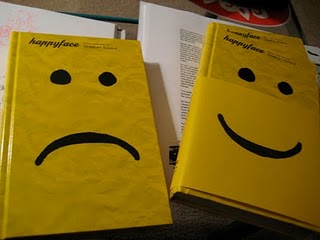
Happyface reminds me a lot of one of my all-time favourite picture books, Michael Rosen's Sad Book. Like the Sad Book, Happyface deals with grief that morphs (as it so easily does) into long-term depression. It also reminds me of Sherman Alexie's The Absolutely True Diary of a Part-Time Indian in that it is heavily illustrated with the narrator's sketches, and the illustrations do a great deal to enhance the mood of the story. There's a lot going on here visually--starting with the cover. With the book jacket on, we see a happy face, but if we look underneath, the face is sad. (Just like Quentin Blake's brilliant first-page illustration for the Sad Book).
Happyface is about an artistic guy whose family falls apart in a horrible way (how horrible it is, we don't learn until about halfway through the book because Happyface can't talk about it) which leaves him feeling deeply betrayed as well as permanently grief-ridden. Happyface and his mother move to a small apartment in a new neighbourhood where his mother drinks too much and rides a private and painful emotional roller coaster, and he goes to a new school where no one knows him. Happyface decides to reinvent himself, and at first he's pretty successful. He "slaps on a grin", gets his nickname, makes friends with the cool crowd, and starts chasing a girl who's beautiful, reads Allen Ginsberg and seems to like him back. He's fooling everyone.
Of course, eventually everything crumbles around him, because a) people start digging for the truth, and b) he starts going just a little nuts, in the way that happens when you repress such powerful feelings. He turns mean and desperate. We're not even sure we like him anymore.
Emond has chosen to give us the closure of a hopeful ending, although I really felt that this book could have gone either way. Happyface mends some rifts, particularly with his father, and vows that "my problems and failures will not stop me, nor will they dictate who I am". Frankly, the ending wasn't my favourite part. What I found fascinating was how well Emond captured the complications of functioning in a depressed state, because, let's face it, Happyface is right--grief and rage are big social turn-offs for most people, particularly if they last a long time. Sometimes the mask is what saves us.
I also found the illustrations extraordinarily engaging. They're plentiful, sometimes cartoony and sometimes more artistically rendered, and they add a lot of energy and vitality to what could otherwise have been a much more sober story. Here's an interesting article written by Connie Tsu on the Blue Rose Girls blog about the process of editing a book as visual as Happyface. Enjoy!
"There's an easy way to do a search and a hard way. The easy way is early in the evening with a cool breeze and a steady partner. The hard way is high noon with a crazy chicken clucking in your ear and two feather balls riding your tail. This search was gonna go the hard way."
This easy chapter book lends itself to dramatic reading. It's a send-up of the hard-boiled detective genre; J.J., a retired search-and-rescue dog, is hired by a local chicken to find two missing chicks (he won't work for chicken feed or feathers, but she promises him a cheeseburger). There are lots of good bits to act out, like:
"I never backed down from a staring contest in my life, but her eyes were so tiny and close-set, it was making me cross-eyed."
or:
"I sucked my breath in through my nose as hard as I could. Sugar was dragged right between the two bars and stuck to my nose like a stray sock on a freshly dried towel."
(Sugar is one of the missing chicks. Just picture it. ) Jokes abound, and they're really funny. One of them involves a ransom note which contains the words "behoove", "rendezvous", and "twilight". Our sardonic narrator J.J. observes:
"I've been lowered from a helicopter, strapped to a snowmobile, and flown first-class to France to find a backcountry skier lost in the Alps. Not once did anyone find it necessary to use the word behoove."
If I want to get a laugh out of my son now, all I have to do is tell him that it behooves him to rendezvous with me at the dinner table.
Like many of the best books for this reading level, lots of illustrations add interest to the text. Here's J.J. enjoying retirement, and J.J. in a peck (bad pun) of trouble.
It's back-to-school time. Since my daughter's going into grade eight, I thought the time for reading her picture books was long over, but that was before I stumbled upon Appetite for Detention. Yes, she was skeptical when I offered to read her a bedtime story for old times sake, but the first ridiculous page won her over. It's the contrast between the cute little toy chicks and the angsty-ironic teen dialogue that makes the book such a laugh. Sloane Tanen has made a niche for herself creating these kinds of images with attitude, so if you like the book, check out her website.
Here are a few sample pages:
If I were in high school now, I'd tape these to my locker.
"I think that from the very beginning Bing was always more curious. A Chinese parasol hung from the ceiling in her room, and she owned a pair of Chinese pajamas. 'Why don't you get a Chinese tattoo?' I said. She pointed at her butt. 'Here?' 'No!' said my mother. 'Yes, right there,' I said. 'Get a dragon.' 'But it has to be a big one,' Bing said. 'A mini dragon would be useless. You'd barely see it.' 'Big and colorful,' I said. 'So it catches your eye. Red, green and blue.' 'And yellow.' Bing said. My mother looked relieved. 'You're overdoing it. I don't believe you anymore.' 'Overdoing it?' said Bing. 'It's my butt and I can do what I want with it.' 'It's also a little bit mine,' my mother said. 'I wiped it for years.' 'All mothers do that,' Bing said. 'That doesn't mean a thing.' "
Dutch author Marjolyn Hof's Mother Number Zero is a quiet and sensitive story about adoption. Fejzo, called Fay, is part of a Dutch family with two adopted children. His sister An Bing Wa, or Peace-Loving Ice Baby, was adopted from China, while Fejzo's mother was originally from Bosnia. He has a child-like understanding of his past: "My mother number zero lived in Bosnia and I was in her belly. Mother number zero didn't want a baby. She couldn't take care of me and that was the reason she gave me up. Luckily she didn't give me away to somebody in her own country, because they had a war and far too many problems. She was smart enough to come to the Netherlands, and I traveled along in her belly."
Fay doesn't give too much thought to his adoption until he meets Maud, a newcomer who is very curious about Fay's birth mother. Maud thinks that Fay's birth mother might be a famous artist, since Fay himself is accomplished at drawing birds. She suggests that Fay might be able to find his mother number zero with a bit of detective work, just like on a TV show called Disappeared, where "they search for someone's father or mother and then you can see what happens." The curiosity Maud exhibits eventually stirs something within Fay, and once he begins wondering about mother number zero, he can't seem to stop.
With his parent's assistance, Fay begins to take steps to find his birth mother. Fay doesn't initially understand the difficult feelings this search may spark for both himself and his family, particularly his sister, who was found abandoned and therefore has no means of tracking her birth family. In him, the search evokes many fantasies, some exciting and some frightening.
"And mother number zero? She had gone through a war and given her kid away....Was my mother like some people who could handle it, or like others who couldn't? If she couldn't, then maybe she lived in a park somewhere too. Maybe she drank beer all day long and had a knife to kill ducks. Maybe that was the answer to the question of why she had given me away. She had gone through so much that she had turned into a bum. Maybe she was crazy. Or wounded or crippled. Maybe she didn't have a nose or only one leg or no arms."
Hof, an adoptee herself, enters Fay's inner world with tremendous empathy and understanding. As Fay's thoughts and feelings veer off in so many different directions, we feel safe knowing that he is blessed with parents who are kind and warm, and deeply connected with him. Their support and guidance on his quest helps him prepare for whatever answer will come.
The ending felt right to me, and I found it very honestly and gently handled. This is a story that is simple but never stark. Reading it feels like taking a small pilgrimage and then coming safely back home.
Although I didn't review British writer Rachel Ward's debut novel Num8ers when it came out last year, I found it intense and fascinating. Num8ers takes place in a contemporary but dystopian England where a girl named Jem has a strange ability: when she looks into people's eyes she sees numbers that represent the date of that person's death. This causes a great deal of trouble for her in terms of the story, as it ultimately leads to her being mistaken for a terrorist . I thought it was an ingenious idea, though. Imagine the questions it raises: is the future preordained? If you warned someone, could you change their fate? Is there a purpose behind this ability? What is the cost to Jem of such knowledge? What makes Jem's situation more intriguing is that she can't see the date of her own death, since of course she can't look herself directly in the eye (mirrors don't work).
Num8ers: The Chaos could also be called Num8ers: The Next Generation. We are now in the year 2026, and Jem has died of cancer. Adam, her son, is living with his grandmother, with whom he often clashes. Adam has inherited his mother's ability to see death in a person's eyes, but in his case the power is intensified: he not only sees the date, he also feels the nature of the death, the emotions and the pain of the process. Because of this disturbing ability and the isolation of being so freakish, he is a troubled, angry teen. He's also scared, because after a flood takes down his mother's old home and his Nan insists they move to London, he can't help but notice that almost everyone he meets has the same death date: January 1st, 2027, and that all of these deaths are traumatic. Something terrible is going to wipe out London soon, and it's up to misfit Adam to do what he can to stop it.
I liked this book even more than Ward's first, in part because having set up the situation already, she can now make it increasingly complex. She adds another point of view, that of Sarah, a girl with big problems and a scary ability of her own. The goverment has grown even more distrustful and controlling, to the point where people are microchipped and can be tracked at all times. The stakes are higher. The ending is unexpected and riveting. But it's not only the tension and suspense that are so compelling; Ward gives her characters a lot of depth and development. This is a book with substance as well as thrills. Ward is planning a third book in the series, titled Num8ers: Infinity, which will focus on Sarah's daughter Mia, so altogether the Num8ers series will span three generations.

 "To provide that boy with the life he has, I've had to eat much bitterness. He must learn to do the same. How will a video game teach him to eat bitterness?"